
Household Tasks
Overview
Frequently Asked Questions
Assistance with Household Tasks is funded under the Core Supports – Assistance with Daily Life budget in your National Disability Insurance Scheme (NDIS) plan. This funding enables you to maintain a safe, clean, and functional home environment if your disability directly prevents you from completing domestic chores independently.
Top 10 Household Tasks Covered Under NDIS Domestic Assistance
What Is NDIS Domestic Assistance?
NDIS Domestic Assistance is a type of assistance in the category of help with the daily mess and helps those people with disabilities who have difficulties with everyday housework. Having a clean, safe and feasible family set-up is helpful as it helps in reducing the lists of duties, such as cleaning, doing the laundry, and preparing meals.
Such a service plays a significant role in enhancing comfort, safety, and autonomy in the house. It makes the participants and their families less physically and emotionally drained as well.
The assistance is customized to a personal level and aims at ensuring quality of life. Though NDIS does not cover expenses such as groceries and cleaning products, it will pay for trained support workers who will help an individual with necessities. The participants can also be advised to develop independent living skills. In general, such support provides an area of support and empowerment in the home, which further contributes to the overall well-being.
Top 10 NDIS-Funded Household Tasks
Discover the most common household tasks supported by the NDIS to help participants live safely, comfortably, and independently at home.
Below are the most funded household tasks through NDIS domestic assistance support:
- General House Cleaning
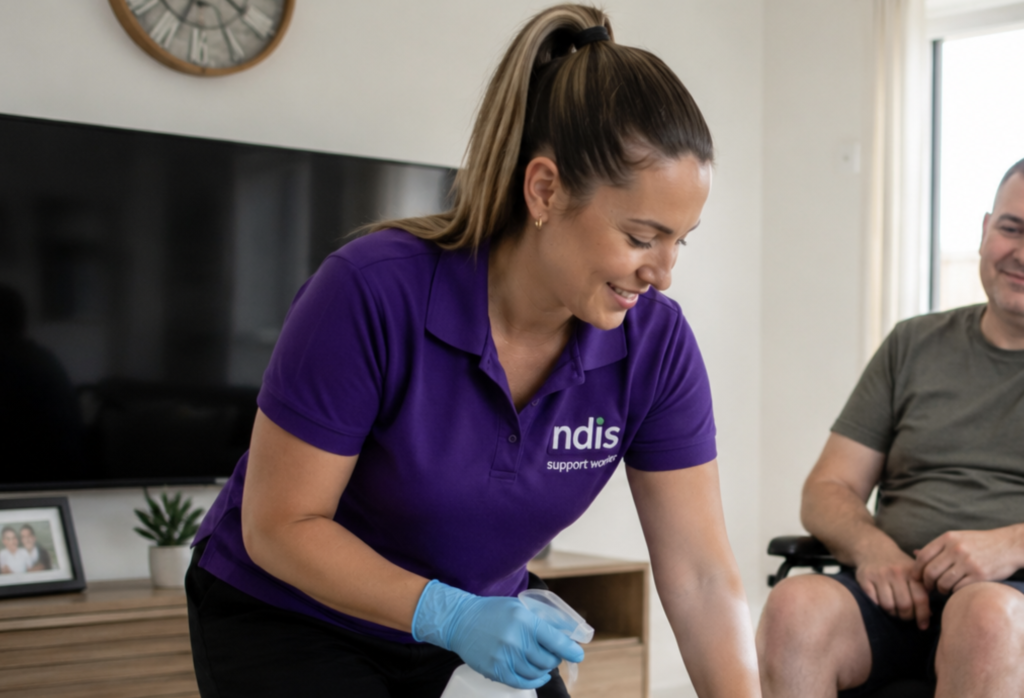
It is absolutely essential to clean the house in order to feel good and fit. NDIS assists the participants in living independently and safely with the help of general house cleaning. This can be in the form of vacuuming carpets, mopping floors, dusting furniture, cleaning benches, windows and mirrors together with rubbish bins.
When someone is of poor mobility, chronically ill, or disabled, such tasks are not always simple. Without drops of sweat rolling on your forehead, without squandering happy moments with the appropriate assistance, your living accommodation can continue to be fresh, healthy, and clean.
- Bathroom and Toilet Cleaning
Bathrooms are also one of the most essential places to be clean, though the physically challenging ones are as well. Domestic care under NDIS may involve scrubbing of toilets, cleaning of the shower and bathtubs, cleaning of tiles, sanitising of surfaces, and changing of bathroom supplies like toilet paper, etc.
A clean bathroom will reduce falls, moulds and infections. It is an essential service to the participants with restricted ability to move or who need a safe and friendly environment.
- Kitchen Cleaning and Maintenance
Clean kitchens will be a safer way of making food and lead to a healthier lifestyle. Some of the cleaning services provided by NDIS include wiping benches and cupboards, cleaning stoves, ovens, and fridges, removal of trash, and arranging pantries.
These are tiny job tasks and seem to be trivial, but make a huge difference, particularly when the participants are fatigued, have joint pain, or suffer from visual impairment. The tidiness of cooking areas can positively affect mental health and cause improved eating.
- Laundry and Ironing
The process of laundry may appear mundane, yet it may be physically challenging. An NDIS domestic assistant can help with washing, drying, folding, ironing clothes, and hanging clothes. Normally, the challenges associated with laundry chores are prone to affect participants who cannot stoop, lift, or hold their posture longer.
It also means that you never have to speak of being out of clean clothes and towels or of not having enough bed linen, which positively impacts hygiene, comfort, and self-confidence, even on a day-to-day basis.
- Changing Bed Linen
A comfortable and clean bed sheet is critical, especially for individuals with chronic illness, disability, or those who often feel low on energy. Home help can be provided under NDIS, and it can include stripping and remaking beds, changing sheets, pillowcases, and blankets, as well as rotating bedding according to the weather.
This is one of the tasks that support workers can take over from participants on a regular basis. It allows them to enjoy a fresh and restful sleeping environment without the burden of heavy lifting.
- Dishwashing and Kitchen Clean-Up
Plates may accumulate within no time, and to a person in trouble who is unable to stand or use their hands, this simple task becomes a significant challenge. NDIS can support the process of hand-washing dishes, loading and unloading the dishwasher, cleaning the tables and kitchen surfaces, and tidying up after meals.
A clean kitchen not only keeps away pests and bacteria but also brings a sense of peace to participants and their careers.
- Meal Preparation Clean-Up
Although cooking itself may not always be discussed, the cleanup that follows is usually covered. Support workers under NDIS may assist in cleaning utensils, benches, and stovetops after cooking, arranging pantry and fridge spaces, and making the kitchen suitable for use again.
This assistance helps participants stay independent while cooking and prevents the physical strain and effort usually required for kitchen clean-up.
- Assistance with Home Organisation
Clutter might be too much to handle, especially for individuals who have a cognitive impairment, anxiety, or mental illness. Organisation of living spaces, paperwork, medicine areas, kitchen cupboards, and wardrobe tidiness are all NDIS-funded support options.
These organisational activities help participants feel less overwhelmed in their surroundings, reduce stress, and create safer, more practical homes.
- Garden and Outdoor Maintenance
Although the NDIS does not commonly fund complete landscaping or full property renovation, simple outdoor repairs are often covered when they improve safety and accessibility.
Some of the services can include lawn cutting, watering plants, and cleaning up paths, leaves, or debris. These tasks help prevent accidents and make the outdoor environment more pleasant for participants.
- Cleaning Mobility Equipment and Aids
Wheelchairs, walkers, and grab rails may seem ordinary, but they are used daily, which makes regular cleaning essential to keep them safe and working well.
NDIS can provide support for cleaning equipment, including support rails, bathroom safety tools, and general assistive aids. This helps participants feel confident that their equipment is safe and easy to use.
Who Can Access These Services?
NDIS-funded household tasks are available to eligible participants who need support with daily living due to disability, limited mobility, or health conditions.
NDIS household help is available for people who:
- Have an active NDIS plan
- Find it hard to do daily tasks at home because of their disability
- Have Assistance with Daily Life included in their plan under Core Supports
- Need support that NDIS sees as reasonable and necessary
- These services are there to make your daily life safer, easier, and more comfortable.
- Household Tasks Support in Melbourne — What to Expect from ANNS
ANNS provides NDIS household tasks support to participants. Our support workers are trained, screened, and matched to participants based on not just practical skills but personal compatibility — because the person coming into your home matters.
What you can expect from ANNS’s household tasks assistance:
A consistent worker. Wherever possible, we assign the same support worker to your regular sessions. This builds familiarity, trust, and efficiency — your worker learns your preferences, your routines, and how you like things done.
Flexible scheduling. Life doesn’t follow a fixed timetable, and neither do we. Whether you need support in the morning, afternoon, or on weekends, we work around your schedule rather than asking you to fit around ours.
Clear communication. Before services begin, we discuss exactly what tasks will be covered, how often, and for how long. There are no surprises in your Service Agreement, and our team is easy to reach if something needs to change.
Respect for your home and your choices. Our workers treat your home with care and follow your lead on how things should be organised and maintained. Your preferences always come first.
To enquire about NDIS household tasks assistance through ANNS, fill out the contact form or call us on 0499 408 244.
How to Add This Support to Your NDIS Plan
If you don’t already have household help in your plan, you can ask to add it. Here’s how:
Talk to your NDIS planner or support coordinator. You can call our NDIS Support Worker to take care of this for you; to market things easier and simpler for you.
Let them know what daily tasks you’re struggling with and why you need support
Gather evidence
This could be a letter from your doctor, therapist, or support worker explaining your needs
Request a plan review
During the review, ask for Assistance with Daily Life to be added under Core Supports
Once it’s approved, you can choose a provider like ANNS to start receiving help.
Why Choose ANNS?
Choosing the right support provider can make a big difference in your daily life. ANNS is here to offer reliable, respectful, and personalised care that puts your needs first.
Friendly and experienced staff who have been trained to offer NDIS support
Services that can be flexibly created daily to fit your life and your specifications
Caring and trustworthy support personnel concentrated on your convenience
Fast reactions and convenient reservations
It is our mission to simplify and improve the safety and cleanliness of your home life, to have time to concentrate on what is important
Conclusion
NDIS household tasks support is more than just cleaning. It is all about freedom, ease, and security. Contact us whenever you require assistance with organising your space and doing chores or taking care of your home security so that ANNS can be helpful at all times.
What are NDIS household tasks and who can access them?
NDIS household tasks are domestic assistance supports funded under a participant’s Core Supports budget to help people with disability maintain a safe, clean, and functional home environment. Eligible participants are those who have an active NDIS plan, find it difficult to perform domestic tasks due to their disability, and have “Assistance with Daily Life” included in their plan.
How do I get household tasks included in my NDIS plan?
To access household tasks NDIS funding, you need supporting evidence showing that domestic assistance is reasonable and necessary due to your disability. Usually an occupational therapist report describing functional limitations is required. Bring this evidence to your NDIS planning meeting or request a plan review.
Does NDIS household tasks assistance cover cleaning products and groceries?
No. NDIS household tasks assistance covers the cost of a support worker helping with tasks, not the cost of cleaning products, groceries, appliances, or consumables.
Can household tasks support be used flexibly within my Core Supports budget?
Yes. Household tasks are funded under Core Supports — Assistance with Daily Life and can usually be used flexibly within your overall Core Supports budget allocation.
What is NOT covered under NDIS household tasks assistance?
The NDIS does not fund groceries, cleaning products, home repairs, landscaping, pest control, appliances, or domestic support for household members without disability.
How many hours of household support can I receive under the NDIS?
The number of hours funded depends on your individual NDIS plan and the evidence provided by your occupational therapist or other health professionals.
Can I choose my own provider for household tasks NDIS support?
Yes. Participants can choose any registered NDIS provider. If your plan is plan-managed or self-managed, you may also access unregistered providers.
Can a family member be paid to provide household tasks support?
Categories
How Can we Help You?